Information Overload and Burnout
Each day, we are faced with another thread of hideous news, each vying to be more insidious than the last. The atrocities of the American empire are being laid bare for all who wish to witness, rushing past us in waves moving so quickly that it is difficult to keep up.
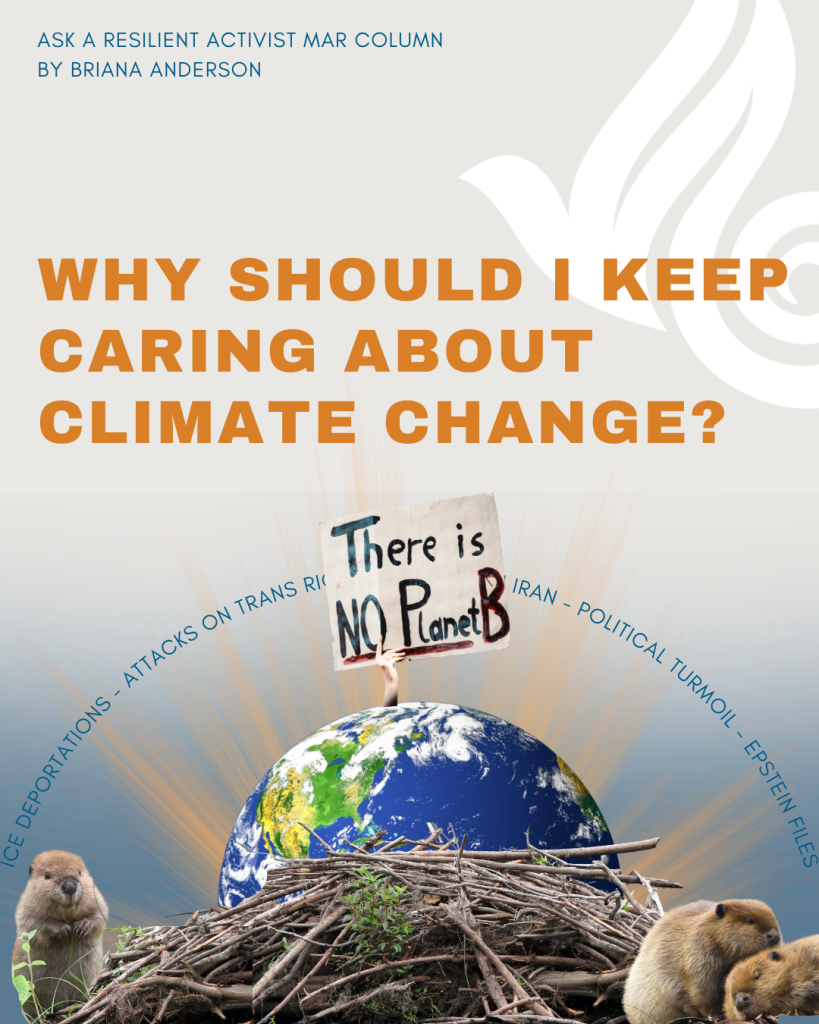
The president posted what?
An ICE agent brutalized who?
Congress just took whose rights away?
Funding for which department was slashed?
Which country’s president still sits in a New York jail?
The files said WHAT?
As I scramble to keep my head above water, signing every petition and calling every elected official who represents me, attending neighborhood support trainings, donating to this cause and that—I am gently nudged by climate change. Oh, right. That.
Amidst everything else, the environment has been shoved to the farthest backburner of my mind. How can I possibly hold space for fossil fuels and agricultural methane emissions and microplastics when I am witnessing the rise of authoritarianism in my country?
It feels trivial—almost inappropriate—to focus my energy on eco-friendly living when it feels like I and my community are perpetually threatened by the current administration.
A Lesson from the Beavers

Pause. Take a deep breath. Look to nature.
Did you know that beavers spring into action at the mere sound of running water?
As nature’s ultimate civil engineers, North America’s largest rodents intricately design the world they want for themselves. Jumping into problem-solving mode at the edge of a rushing stream, beavers work together as a family unit—systematically impeding the flow of water until it is cut off entirely by a dam.
Placing logs and limbs along the banks, weighing them down with heavy rocks, and packing handfuls of grass in between with mud patties in the crevices—each is a contribution to the slowing of the flood.
Piece by piece, a lodge is assembled, which serves as a safe, warm home for an entire family. These structures can be huge. One beaver dam in Montana was measured to be 14 feet tall, 23 feet thick, and 2,139 feet long.
By creating such complex infrastructure, beavers modify the entire surrounding ecosystem. What was once a rushing stream of water becomes a calm pond. Wetland habitats that wouldn’t otherwise exist are able to thrive, along with dozens of plant and animal species who rely on these ecosystems.
Building a Dam, Together
Beaver dams are a natural flood control mechanism and an erosion deterrent. They filter out toxic pollutants from the water. Beaver ponds are refuges during wildfires. Salmon and trout use the ponds for spawning. Tadpoles can safely develop into frogs. Turtles and waterfowl can peacefully exist. Bats are drawn to the increased insect populations.
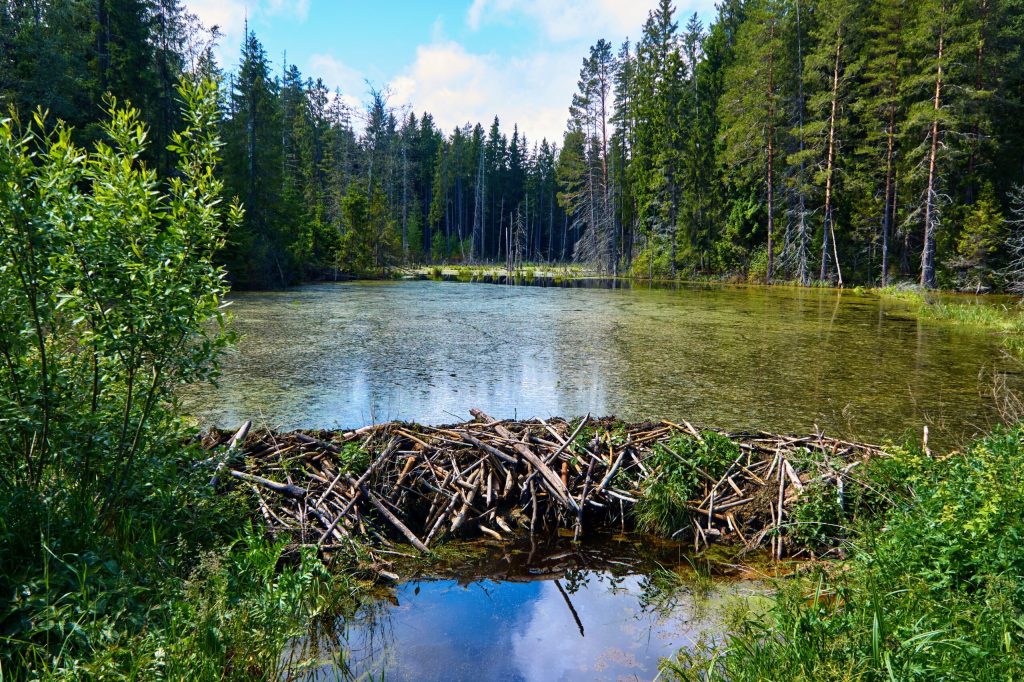
In essence, everybody benefits. One beaver’s actions are interwoven with the safety of their family, the quality of the habitat, and the opportunity for dozens of plant and animal species to thrive.
Would My Actions Have a Similar Ripple Effect?
If I email my council member about my city’s attempts to scrap its energy efficiency building codes, that is one rock placed in the rushing waters, ebbing the flow just a bit. If I purchase a plastic-free product at a small local business, that is another rock. Every action taken, no matter how big or small, is a contribution to the waning of the flood—and its effects benefit us all.
The struggle still remains in choosing which actions to focus on, which horrific piece of news to prioritize. It still feels a tad frivolous to place energy efficiency codes at the top of the priority list.
It is critical to acknowledge the interconnectedness of climate change, its culprits, and the other ongoing crises. There is no separating environmental damage from the current violence imposed by the state on its citizens.
Those who are facilitating the ongoing climate crisis are conducting acts of violence on our communities by polluting our waterways, degrading our soils, toxifying our air, and diminishing biodiversity.
There is a deliberate choice in concentrating the most polluting infrastructure in black, brown, and impoverished communities—from coal plants to concentrated animal feeding operations to plastics manufacturers.**
The fossil fuel industry, climate change’s biggest culprit, is one of the top funders of Donald Trump’s administration. By providing $75 million dollars to the election campaign and over $11 million more to the inauguration fund, fossil fuel companies have enjoyed several benefits.
Since taking office, this administration has been prioritizing drilling projects on public lands, giving oil and gas companies $18 billion in tax incentives, and working to repeal the “endangerment finding”—the federal government’s formal acknowledgment that burning fossil fuels causes global warming, which is a danger to the public.***
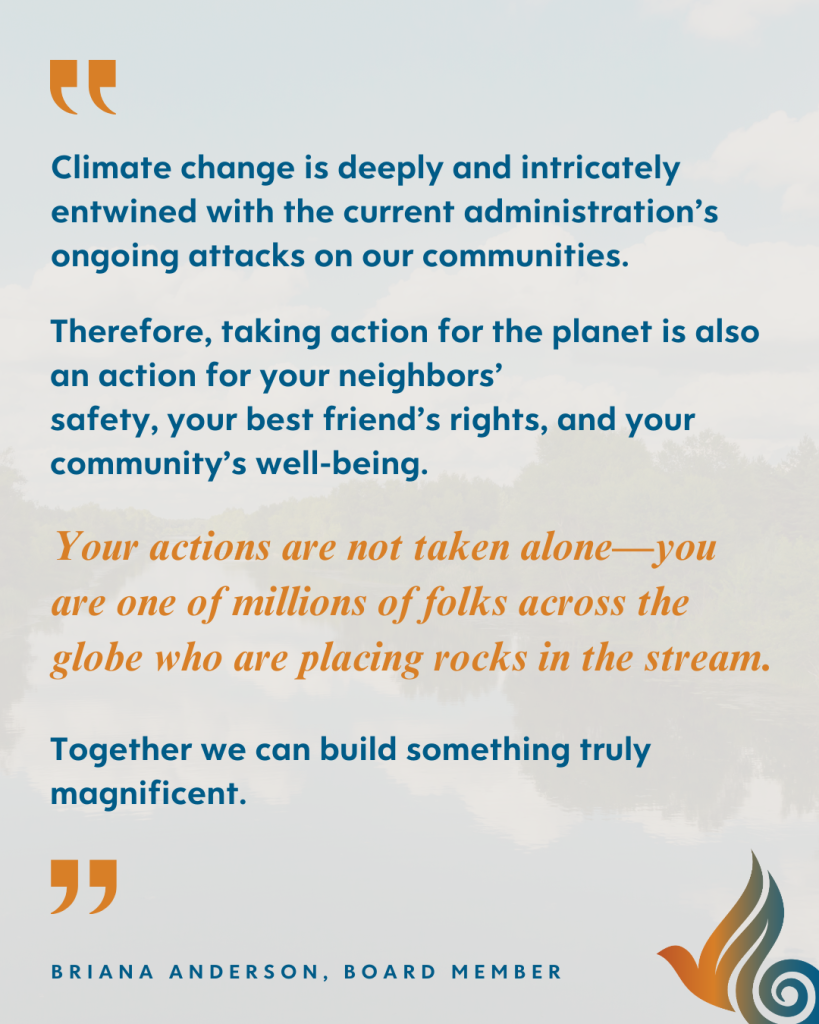
Climate change is deeply and intricately entwined with the current administration’s ongoing attacks on our communities.
Therefore, taking action for the planet is also an action for your neighbors’ safety, your best friend’s rights, and your community’s well-being.
An environmental action is a rock placed in the streaming flood of hostility coming from the White House. The beaver knows that a handful of grass is just as important as a massive log in slowing the flow of water. The beaver also knows that they aren’t alone. The entire family works together, taking different actions to achieve the same goal.
Remember the wisdom of the beavers as you continue in your activism: your actions, no matter how big or small, have a ripple effect far beyond the immediate benefits.
Your actions are not taken alone – you are one of millions of folks across the globe who are placing rocks in the stream. Together we can build something truly magnificent.
Sources:
*Strege, David. “Explorer first to reach world’s largest beaver dam”. Archived from the original on 24 September 2014. Retrieved 24 September 2014.
** A Terrible Thing to Waste: Environmental Racism and its Assault on the American Mind by Harriet A. Washington.*** 10161. 2025. “Fossil Fuel Industry Donors See Major Returns in Trump’s Policies.” Brennan Center for Justice. July 21, 2025.