Another World is not only possible, she is on her way. On a quiet day, I can hear her breathing. – Arundhati Roy
The world is in the midst of a profound sea change.
On the global stage, long-standing alliances are fraying as powerful nations posture, intimidate, and attempt to extract resources from their smaller neighbors. Here at home, the U.S. government no longer seems to operate according to shared norms, as the current administration advances policies that benefit a small few while leaving the needs of most Americans unmet.
All of this is unfolding while the cost of daily living continues to rise, the Earth is further harmed by human activity, and the social systems many of us rely on strain and sputter just to remain functional. And then there’s artificial intelligence—rapidly advancing, largely unregulated, and carrying the potential to radically reshape life as we know it.
Living through this kind of upheaval can be dizzying. Many of us are pouring enormous amounts of energy into simply adapting, even as we grieve the loss of familiar structures and ways of life—sacrificed in service of a zero-sum game few truly benefit from.
Time Is a Line and a Circle
Watching the systems we depend on reveal their fragility can be deeply unsettling.
Still, it’s worth remembering that this pattern is not new. Change, collapse, and renewal are woven into the fabric of existence.
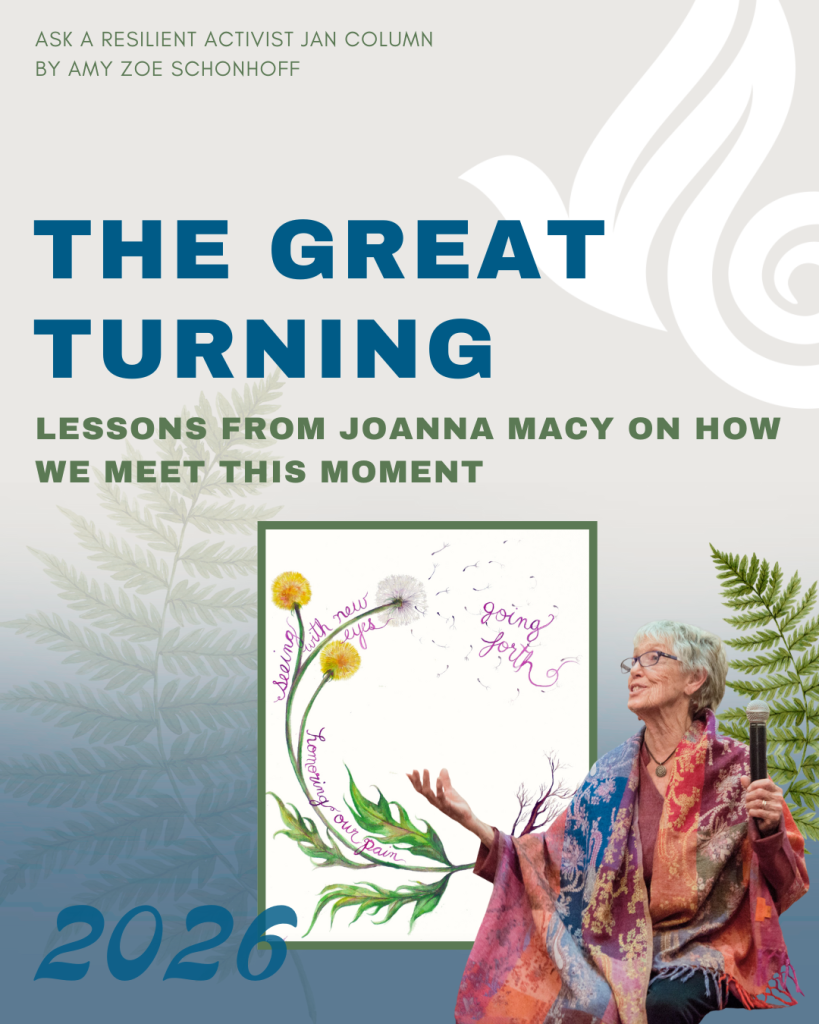
The ancient symbol of the Ouroboros—the snake eating its own tail—reminds us that all things move through cycles of birth, death, and rebirth. Nothing, not even the most powerful governments or economic systems, can grow indefinitely without eventually collapsing under its own weight. Like an unchecked cancer that ultimately destroys its host, history shows us again and again that perpetual expansion gives rise to bloated systems that cannot sustain themselves.
The multi-layered crises we are living through today are not entirely unpredictable. The rapid changes we’re witnessing are the result of decades—if not centuries—of unchecked growth, extraction, and consumption. The many problems we’ve deferred for the sake of short-term gain are now, quite simply, coming due.
And yet, even as these times feel extraordinarily challenging, Buddhist scholar and eco-activist Joanna Macy offered a radically different way of understanding this moment. She suggested that what we are experiencing may be part of a collective awakening grounded in two essential truths:
- The industrial growth society is built on extractive, oppressive systems that ultimately threaten all life on Earth.
- Humanity’s needs can be met without causing irreparable harm to the planet and its many inhabitants.
Macy’s vision for a prolonged period of global transformation—often referred to as The Great Turning—offers a framework for moving away from systems shaped by colonialism, white supremacy, and patriarchy, and toward a life-sustaining civilization grounded in an understanding of the cyclical nature of living systems.
What Is The Great Turning?
Joanna Macy began articulating what would come to be known as The Great Turning through her activism, writings, and teachings in the 1970s and ’80s. Looking across history, she identified several moments of profound transformation in collective human consciousness—and believed we are now living through a fourth such turning.
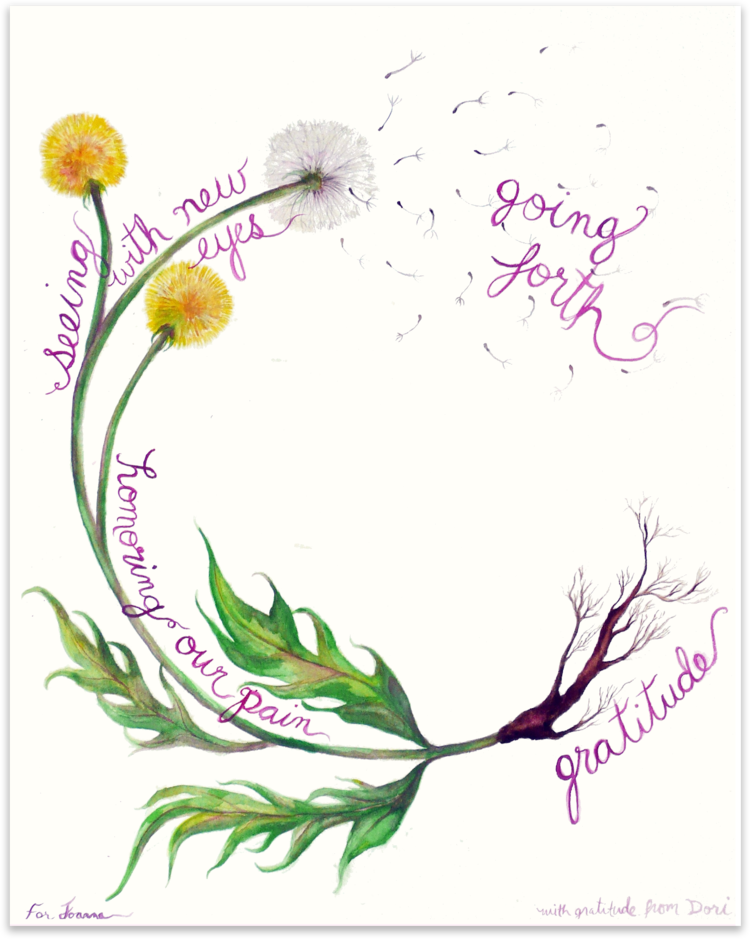
In this current Great Turning, Macy suggested that humanity is being called to move away from the destructive patterns of the industrial growth society and toward a more life-affirming way of organizing our world. She argued that widespread dissatisfaction with toxic, imbalanced systems—combined with technological and scientific discoveries that affirm the intelligence and interconnectedness of nature—would catalyze a fundamental shift in worldview.
This shift moves us from a human-centered, ego-driven relationship with the Earth—one rooted in domination and control—toward an understanding that we are simply one thread in a vast, living web of life.
As our awareness deepens, Macy believed momentum would build over time to intentionally dismantle outdated systems and replace them with new ones rooted in restorative practices, Indigenous wisdom, science, and spirituality.
The Path from Here to There
According to Macy, the transition to a life-sustaining civilization requires sustained effort on three interconnected fronts—both individually and collectively.
- Holding Actions
These are the forms of activism that work to slow the damage being caused by existing systems. Holding actions can be large or small, public or quiet, but they share a commitment to non-harming resistance. They expose hypocrisy, disrupt destructive practices, and actively defend those—human and more-than-human—who are most vulnerable.
Holding actions can look like civil disobedience, education, direct action, or blowing the whistle on unethical practices—and although they are impactful, they alone are insufficient for achieving the Great Turning.
- Creating New Structures
If we want harmful systems to fade into history, we must actively build their replacements. This means creating new institutions, economic models, and ways of living that are regenerative, sustainable, and rooted in equity. The future doesn’t emerge on its own—we practice it into being.
The structures we build should reflect the future we want to live in. They could range from establishing equitable decision-making and power-sharing frameworks to adopting permaculture practices within local communities.
- Shifting Consciousness
For centuries, humanity has positioned itself as separate from—and superior to—the natural world. This belief has brought us to the brink of ecological collapse. By realigning ourselves with life, we begin to remember that we are interconnected, interdependent, and part of a much larger mystery. This shift in consciousness is not an abstract idea; it’s a necessary foundation for the enduring transformation we hope to sustain.
When you act on behalf of something greater than yourself, you begin to feel it acting through you with a power that is greater than your own. – Joanna Macy
Coming Back to Life
At its heart, The Great Turning is not simply a theory about social change—it is a lived practice. Joanna Macy understood we cannot think our way into a life-sustaining future if our bodies, emotions, and spirits remain disconnected from the living world we are trying to protect.
This is why she developed The Work That Reconnects: a set of experiential practices designed to help people remember their belonging within the web of life and to integrate the pain and beauty of living through these times.
The Great Turning invites us to see the world not as a collection of isolated problems to be solved, but as a living, interconnected system of relationships. When we begin to understand reality this way, exploitation becomes far more difficult—because what we harm, we ultimately harm in ourselves.
From this place of recognition, care for the Earth is no longer a moral obligation or a political stance; it becomes an expression of self-respect and belonging.
Crucially, The Great Turning does not ask us to bypass the emotional reality of our time. Macy insisted that our grief for the world is not a weakness, but a sign of our deep love and connection.
In a culture that encourages constant productivity, forced optimism, and emotional numbing, The Great Turning makes space for grief, fear, anger, gratitude, and awe—recognizing these feelings not as obstacles, but as sources of vital energy. When these emotions are acknowledged and held collectively, grief becomes a pathway back to belonging, and gratitude becomes fuel for sustained engagement.
The Great Turning is not built on passive optimism or assurances of success. It is a practice we undertake—a commitment to participate in shaping the future, even when outcomes are uncertain.
It shifts the question from “Will things turn out okay?” to “What is life asking of me now?” In this way, hope becomes something we enact through our choices and relationships, rather than something we wait to feel.
A Deep Time Perspective to See Us Through
Finally, The Great Turning invites us into a relationship with deep time. Macy reminded us that humanity has faced moments of collapse and transformation before, and that our actions today ripple far beyond our own lifetimes. We are accountable not only to one another, but to past and future generations, and to the more-than-human world. Seen through this lens, even small acts of care, resistance, and restoration carry profound significance.
The Great Turning is already underway—not as a single movement or solution, but as countless acts of remembering, reconnecting, and reimagining happening all over the world.
The question is not whether change is coming, but how we will meet it: with numbness or with courage, with isolation or with relationship, with despair or with a fierce love for life.