We’re sharing a wild new game, just released: “2026: The Year Humanity Saves The Planet!”
Here’s how it’s played…
The Setup
All of humanity lives on a planet (we’ll call it “Earth”) that needs to be shifted away from the socially and ecologically destructive path elite classes have pushed for 300+ years.
The object of the game is to SAVE THE PLANET so it can support and nurture all beings – human and non-human – and become regenerative into the far future.
Between 1 and 8.3 billion people can play. And it’s fun and rewarding for all ages!
The Rules
The only rule is that humans need to act and start playing the game immediately.
It’s okay to start with small steps, and work your way up from there! Playing the game is made easier when you invite friends and loved ones to play with you, and thus, maximize your impact.
Scientists anticipate that if Earth’s temperature trajectory continues as it has and rises by 1.5 degrees Celsius, we could lose approximately 40% of our current mass of glaciers by 2100. As happens in Sci-Fi stories, that’ll be when all hell breaks loose!

The Play
To play, participants notice and make choices about their daily activities and how these affect Earth.
If the player makes a nurturing choice, plants and wildlife celebrate by displaying their vibrant colors and crazy mating rituals!
If the player makes a destructive choice, plants and wildlife suffer, also reducing the quality of life for humans (plants and wildlife are needed for breathable air, drinkable water, and more).
Want to play? (FYI, even if you say “No”, guess what? You’re already playing! Just by breathing, eating, driving, living in a home and clothing yourself, you’re already a valued and vital participant!)

Scoring
Each time you consciously make an Earth-friendly choice (contact representatives to protect public lands, compost, plant native species, etc.), your entire body reacts with joy and delight! You know you’ve scored big when your heart lights up.
Each time you consciously make a destructive choice (throw away items that could be donated, purchase from destructive companies, etc.), nature mourns.
Bonus points are earned for supporting the protection of lush forests, sparkling rivers teeming with fish, oceans of abundant marine life, glorious coral reefs, and other wildlands.
Not Sure How to Play? You’re Not Alone!
To help you on this earth-friendly journey, we’ve included special “EnviroTip” cards to assist you! These EnviroTip cards can be “played” over and over. Collect bonus points for sharing them with other players!
Our EnviroTips encourage you to take simple steps that will make a big impact, such as choosing to:
- Actively “Green” our planet: Plant native trees, shrubs, and wildflowers to benefit wildlife and nature.
- Choose who you give your money to: Use your purchasing power to benefit Earth, plants, wildlife, and humans.
- Nurture compassion for all beings: From beneficial pollinators to bugs on your vegetables, you can help honor and nurture plants and critters in everything you do.
- Manage your waste to replenish Earth: Tips on recycling, trash, and food waste (rack up extra gold stars if you compost your food scraps!)
- Spend time in nature: Earn special prizes as you reap the physical and emotional benefits that come from being out-of-doors in glorious places.
How Does the Game End?
Which will it be: Earth wins or Earth loses? The choice is ours.
A Light-hearted Game For A Serious Topic

There is just ONE important message here: we can choose to give back to our planet starting today. How do we do that? By making a conscious decision for 2026 to focus on our personal impact on Earth. With over 8 billion people living on this planet, we do a whole lot of “taking” – of food, water, energy, land, and more.
The best way to keep the planet healthy enough to support humans and all the other glorious creatures and places we love, for eons to come, is for us to replenish what we take as often as we can. And if you think your actions aren’t important enough to make a difference, consider the honeybee:

- A honeybee visits 50 to 100 flowers during one collection flight from the hive.
- In order to produce 1 pound of honey, bees will have visited 2 million flowers.
- An average worker bee makes only about 1/12 teaspoon of honey in its lifetime.
Humanity must step into the hive mindset. If each of us makes our 1/12 teaspoon of healthy planet we can be assured of having the clean air and fresh water that are vital to us all.
So, throughout your day, get into the habit of asking yourself, “How can I give back to our planet in this moment?”
Read through our EnviroTips below to make 2026 the year that you find new habits, release habits that no longer serve you or Earth, and inhabit a new, regenerative way of living your life.
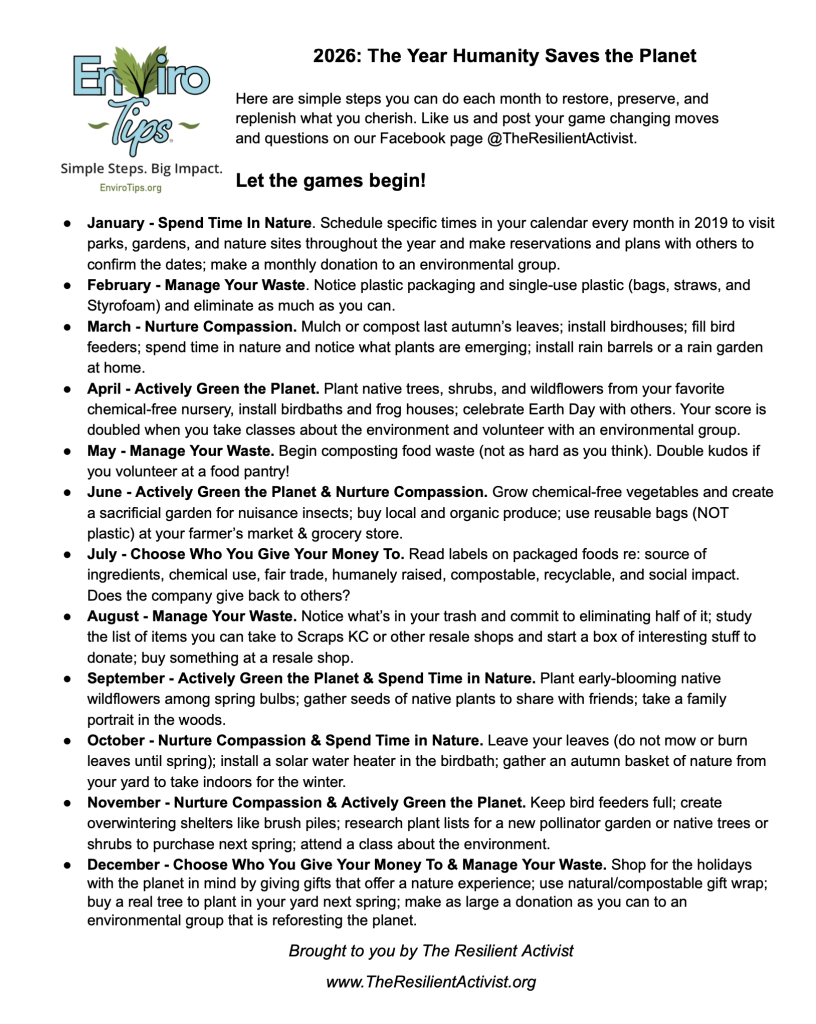
EnviroTips: Simple Steps. Big Impact.
Print and save our EnviroTips to reference all year!
January – Spend Time In Nature. Schedule specific times in your calendar every month in 2019 to visit parks, gardens, and nature sites throughout the year and make reservations. Be present with the songs and sights of nature, reminding you why it’s so important. Make a monthly donation to an environmental group.
February – Manage Your Waste. Notice plastic packaging and single-use plastic (bags, straws, and Styrofoam) and eliminate as much as you can.
March – Nurture Compassion. Mulch or compost last autumnʼs leaves; install birdhouses; fill bird feeders; spend time in nature and notice what plants are emerging; install rain barrels or a rain garden at home.
April – Actively Green the Planet. Plant native trees, shrubs, and wildflowers from your favorite chemical-free nursery, install birdbaths and frog houses; celebrate Earth Day with others. Your score is doubled when you take classes about the environment and volunteer with an environmental group.
May – Manage Your Waste. Begin composting food waste (check out this simple how-to guide). Double kudos if you volunteer at a food pantry!
June – Actively Green the Planet & Nurture Compassion. Grow chemical-free vegetables and create a sacrificial garden for nuisance insects; buy local and organic produce; use reusable bags (NOT plastic) at your farmerʼs market & grocery store.
July – Choose Who You Give Your Money To. Read labels on packaged foods re: source of ingredients, chemical use, fair trade, humanely raised, compostable, recyclable, and social impact. Does the company give back to others?
August – Manage Your Waste. Notice whatʼs in your trash and commit to eliminating half of it; study the list of items you can take to Scraps KC or other resale shops and start a box of interesting stuff to donate; buy something at a resale shop.
September – Actively Green the Planet & Spend Time in Nature. Plant early-blooming native wildflowers among spring bulbs; gather seeds of native plants to share with friends; take a family portrait in the woods.
October – Nurture Compassion & Spend Time in Nature. Leave your leaves (do not mow or burn leaves until spring); install a solar water heater in the birdbath; gather an autumn basket of nature from your yard to take indoors for the winter.
November – Nurture Compassion & Actively Green the Planet. Keep bird feeders full; create overwintering shelters like brush piles; research plant lists for a new pollinator garden or native trees or shrubs to purchase next spring; attend a class about the environment.
December – Choose Who You Give Your Money To & Manage Your Waste. Shop for the holidays with the planet in mind by giving gifts that offer a nature experience; use natural/ compostable gift wrap; buy a real tree to plant in your yard next spring; make as large a donation as you can to an environmental group that is reforesting the planet.u
An earlier version of this article was published in the January 2019 issue of Evolving Magazine.